Registration open for Urban Regulations and Political Memory – an international and interdisciplinary course for this winter semster
4EU+ Course
Urban Regulations and Political Memory: Towards Understanding Spatio-Temporal Aspects of Urban Development (UNREAD)
Course description:
„Urban Regulations and Political Memory: Towards Understanding Spatio-Temporal Aspects of Urban Development” is an international, interdisciplinary course organised by five 4EU+ member universities: University of Warsaw, University of Milan, Charles University, Sorbonne University, Heidelberg University as part of the 4EU+ joint educational offer during the academic year 2025/2026.
Key topics of the course are the driving forces of urban changes, development of smart cities and interdisciplinary methodologies of urban studies. The course is developed as part of an educational project which addresses changes in the conditions of the urban development of smart cities in Poland, Italy, Czechia and Germany, according to three dimensions: past (history), present (law) and future (geography). Emphasis is put on integrated and interdisciplinary approach in order to help students understand the complexity of new urban centres in which real estate development must coexist with the protection of the environment and with the history and heritage of the local community.
The course will be conducted by an interdisciplinary team of historians, lawyers, geographers and educational sciences specialists.- Course dates: virtual part – Wednesdays afternoons, starting from 8 October 2025 (13:15-14:45 / 13:15-15:45 / 13:15-16:30); on-site part 23-27 February 2026
- Language of instruction: English.
- Number of online didactic hours: 47 (lectures and workshops): 27 virtual hours (October – December 2025), 20 on-site hours (23-27 February 2026)
- Assessment methods and conditions for obtaining credit: Group work: producing an essay and delivering a presentation (each student group has to comprise participants from different universities). Essays will be presented at a face-to-face conference (2 days) held at the University of Warsaw in February 2026 during 5 days on-site period of the course.
- ECTS: 6.
How to apply?
- The students will be selected based on their CV and motivation letter.
- The deadline for sending the documents is 23 September 2025.
- The CV and the motivation letter should be sent as a single PDF document to unread@wpia.uw.edu.pl
- The file’s name should contain the applicant’s name (surname_name.pdf), and the subject of the email should be “UNREAD recruitment”.
- The motivation letter should indicate the students’ objectives and motivations for taking the course.
- The motivation letter should not exceed 1,000 characters.
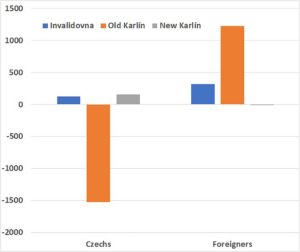 The paper on the basis of detailed migration data, shows the structure of in-migration (invasion of gentrifiers) and out-migration (displacement) in Karlín during the 2010-2020 period. In contrast to many authors from CEE countries, Adela and Martin argue that in selected neighbourhoods of Prague, classical gentrification has developed instead of other inner city transformation processes. Foreigners are the main group of gentrifiers, while the Czech population has the highest out-migration rate in recent years.
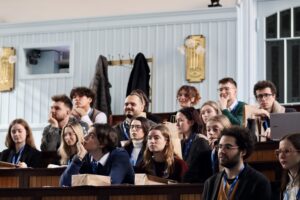 The concluding conference of the 4EU+ course, “Urban Regulations and Political Memory: Towards Understanding Spatio-Temporal Aspects of Urban Development,” was held in Prague at the Faculty of Science from March 26 to 28, organised by